
Two-thirds of associations are citing declining meetings revenue. Sixty-five percent report declining membership. Dues increases have more than doubled year-over-year, and 38% of organizations are now less likely to host multinational meetings in the U.S. than they were six months ago. By any conventional read, the numbers say associations are losing ground.
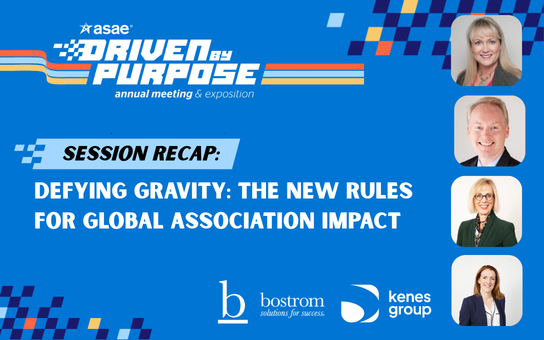
But at ASAE’s 2026 Annual Meeting & Exposition in Indianapolis, we convened a different conversation. Alongside Avital Rosen and Louise Gorringe of Kenes Group, and Peter Doherty, CAE, Bostrom Account Executive and Executive Director of the International Biometric Society, we asked a harder question: if the ground is shifting under every association, why are some organizations still growing, some of them dramatically? The session, “Defying Gravity: The New Rules for Global Association Impact,” pulled together case studies, live data from the room, and a practical framework for the associations ready to build global relevance instead of waiting for it to arrive. Here’s what we covered, and what your association can do with it starting Monday.
1. Growth Is Still Possible But the Old Playbook Won’t Get You There
We opened by putting three myths to the room: that raising dues is a sustainable growth strategy, that most associations are financially thriving right now, and that membership decline is the biggest challenge associations face today. None of them hold up. The ASAE *State of Associations 2026* report and MPI’s Q1 2026 Meetings Outlook paint a genuinely difficult picture: financial decline, falling meetings revenue, shrinking membership, and dues increases that are losing their effectiveness as a lever.
Here’s the reframe: those numbers are a stress signal, not a strategy. Not every association is declining. Some are defying gravity by building global communities and turning disruption into a competitive advantage. The International Biometric Society is one of them. Its flagship conference, IBC, grew from 491 attendees in 2022 to 955 in 2026 — nearly double — with non-member attendance more than doubling and scientific session submissions climbing right alongside it. That growth didn’t come from raising dues. It came from rethinking who the organization was actually serving, and where.
2. Your Members Are Already Global. Is Your Organization Built to Serve Them?
The global appetite is real, even amid geopolitical tension but readiness is uneven. We walked the room through a five-dimension self-assessment that any association can run with its own leadership team: Does your organization have the revenue stability to invest in international growth on an 18–24 month ROI timeline? Can your core systems: AMS, payment processing, communications platforms actually support international operations? Are your board and executive leadership aligned on the value of a global strategy? Do you deeply understand why international members join, what they need, and where they struggle? And can your culture tolerate building something new with real uncertainty before you see proof points?
Most associations will score unevenly across those five dimensions, and that’s the point. The International Papillomavirus Society (IPVS) offers a model for what closing those gaps can produce: membership grew from 576 in 2022 to 1,529 by 2025, a record, and a 160% year-over-year jump at its peak with half of its members now coming from Africa and Asia, up from a historically underrepresented base. IPVS didn’t get there with a single global campaign. It combined country ambassadors, tiered membership pricing, conference-linked packages, year-round communications, and early-career programming which was a deliberate, multi-lever strategy built for very different regional realities.
3. Global Standards, Local Reality
One of the sharpest tensions any international association faces is credibility versus access: what works in North America doesn’t always work everywhere else, and loosening control doesn’t mean diluting standards. The distinction that matters is between what must stay consistent and what can be adapted. Mission, quality standards, scientific integrity, core competencies, and outcomes are non-negotiable; they’re what make your credential or your content trustworthy anywhere in the world. Delivery model, learning format, language, access pathways, and regional implementation are where associations have far more room to flex than most boards assume.
That flexibility shows up in engagement models too. Avital Rosen shared how the Advanced Technologies & Treatments for Diabetes (ATTD) rebuilt its engagement strategy around a simple but consequential shift: events drive engagement, but year-round value drives retention. That means on-demand courses and video, a digital community for healthcare professionals, AI-powered and interactive learning modules including generative AI used to simulate real clinical conversations, monthly live webinars, accredited e-learning conversion, and microlearning blocks that build toward diploma courses and certifications. The annual conference stopped being the whole relationship and became the anchor for one that runs all year.
4. AI’s Real Opportunity Isn’t Efficiency; It’s Revenue
Most associations are already using AI, but they’re using it to save time, not to build something new. Recent studies show, 87.5% of associations reported using AI for efficiency; only 15–20% are using it to build new revenue. That gap is the opportunity and it’s the center of the four-step framework we laid out for turning disruption into durable revenue.
Step one: redefine the business model. Ask your board the uncomfortable question directly: if your association disappeared tomorrow, what would the world actually lose? Most organizations discover they’re sitting on assets they’ve never treated as strategic: research data, certification frameworks, workforce surveys, a trusted brand.
Step two: deliver value with AI, not just internal efficiency, but speed to market, personalization at scale, and multilingual reach that lets you serve global members credibly for the first time.
Step three: co-create with your community. The associations winning here have stopped thinking of themselves as event hosts and started thinking of themselves as content ecosystem builders with members and partners as co-creators of research, on-demand content, expert perspectives, tools and templates, and globally distributed, translated material, not just buyers of a single live experience.
Step four: diversify the revenue mix itself, across research and data licensing, learning and certification subscriptions, community and peer networks, and evolved sponsor partnerships. IBS’s year-round engagement model has produced 23% higher renewal rates; concrete evidence that this isn’t theoretical.
Do This Monday
We closed the session with specific, low-risk starting points, because none of this requires a board vote on a global overhaul:
- Score yourself for real, not just live. Take the five-dimension readiness assessment — financial health, operational readiness, leadership alignment, member intelligence, risk tolerance — back to your leadership team as an actual audit. Identify your single lowest-scoring dimension and name one 90-day action against it. That’s your entry point, not all five at once.
- Pilot tiered access in your weakest region. Borrow IPVS’s playbook — country ambassadors plus tiered dues for lower-income markets — and pressure-test it in just one region where you have low penetration. A single-country pilot is enough to bring a real case to the board.
- Turn one flagship program into a year-round ecosystem. Following ATTD’s model, pick one signature session or course and rebuild it with an on-demand replay, a community layer, and a certification or credential path. Prove it on one asset before touching the rest of your portfolio.
- Audit what you actually own. Inventory your hidden assets: research data, certification frameworks, workforce surveys, brand trust and test just one against the real question: would members pay for this on its own? That’s the difference between “sounds good” and validated.
- Reframe one sponsor relationship as co-creation. Identify a partner who’s a genuine candidate to move from logo placement to content builder, and have that specific conversation before your next renewal cycle.
The Common Thread
What connects readiness, engagement, and revenue is the same insight underneath every genuine growth story told: the associations defying gravity aren’t the ones with the biggest budgets. They’re the ones willing to think differently about what their association actually is, who their members really are, and how to serve them, regardless of geography or geopolitics.
The gravity is real. So is the way past it.
Jeanne Sheehy is Chief Marketing Officer, Co-Owner, and Secretary at Bostrom, an AMC Institute-accredited association management company headquartered in Chicago, IL, serving nearly 30 trade and professional associations. She leads Bostrom’s AI Council and speaks nationally on AI, global expansion, marketing value proposition, and revenue diversification.